

A food processor is one of those kitchen appliances that can genuinely transform the way you cook — or become a £150 piece of plastic that never leaves the cupboard. The difference almost always comes down to whether you bought the right one for the way you actually cook. Too small and it frustrates you. Too powerful and complex and you never bother getting it out. This guide walks you through every decision you need to make, so you end up with a food processor that earns its counter space every week.
What's in This Guide
- What a food processor actually does
- Types of food processor
- Capacity: how to choose the right bowl size
- Motor power explained
- Blades and attachments: what you need vs what you don't
- Bowl design and build quality
- Speed settings and controls
- Noise levels
- Ease of cleaning
- Size and storage
- UK brands worth knowing
- Common buying mistakes to avoid
- Final buying checklist
1. What a Food Processor Actually Does
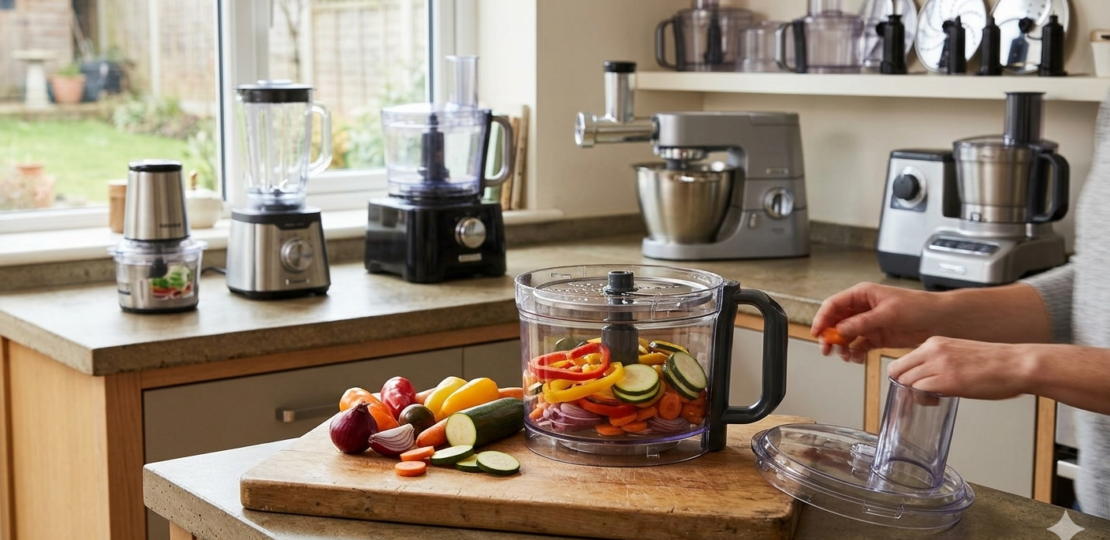
A food processor uses interchangeable blades and discs, driven by an electric motor, to carry out repetitive food preparation tasks that would take much longer by hand. Unlike a blender — which is designed primarily for liquids — a food processor is built for solid and semi-solid foods. It can chop onions, slice cucumbers, grate cheese, shred cabbage, knead bread dough, whip cream, make pastry, purée soups, and mix cake batter, all with a change of attachment.
The key question to ask yourself before buying is: which of these tasks do I actually do regularly? A baker needs different things from a food processor than someone who mainly wants to speed up vegetable prep. Knowing your answer will guide almost every other decision in this guide.
Food processor vs blender vs mini chopper:
A blender excels at liquids — smoothies, soups, sauces. It is not designed for dry chopping or slicing.
A mini chopper (like the Ninja Professional Stackable) handles small-batch chopping, garlic, herbs, and dips quickly. It is compact and easy to clean, but limited in capacity and function.
A full food processor does everything above and more — slicing, grating, dough, pastry, large-batch prep. It takes up more space and costs more, but replaces several other tools.
2. Types of Food Processor
Food processors sold in the UK broadly fall into three categories, each suited to a different type of household.
Mini Food Processors (up to 1.5L)
Compact, affordable, and quick to get out and clean. Mini processors are ideal for singles, couples, or anyone with limited worktop and storage space. They handle chopping, garlic and herb mincing, small-batch dips, and purées with ease. Their limitation is capacity — you'll need to work in batches for anything larger than two or three portions.
Standard Food Processors (1.5L–3L)
The most versatile and popular category for UK households. A 2–3L bowl handles everyday cooking for a family of four, including batch prep, slicing vegetables, making pastry, and kneading dough. Most models in this range come with a full set of blades and discs. This is the right starting point for most buyers.
Large / Professional Food Processors (3L+)
Designed for serious batch cooking, large families, or keen bakers who regularly prepare large quantities. Bowls of 3.5L or above give you genuine flexibility, but these machines are bulkier, heavier, noisier, and more expensive. They are worth the investment if you cook for six or more people regularly or bake large batches weekly — but overkill for most households.
3. Capacity: How to Choose the Right Bowl Size
Bowl capacity is probably the most important single decision when choosing a food processor. Too small and you spend the whole time emptying and refilling. Too large and the processor does a poor job with small quantities, and takes up storage space you may not have.
| Household Size | Recommended Bowl Size | Typical Use |
|---|---|---|
| 1–2 people | Up to 2L | Quick chopping, dips, small-batch prep |
| 3–4 people | 2–3L | Family meals, everyday slicing and grating |
| 5+ people or batch cookers | 3L+ | Large-batch prep, dough, weekly meal prep |
| Bakers (bread, pastry) | 1.9L minimum | Enough dough for a medium loaf or 8-inch cake |
One important nuance: most food processors have a maximum fill line that is lower than the stated bowl capacity. A 2.5L bowl may only be rated to process 1.5L of liquid or soft ingredients safely before leaking around the blade. Always check the maximum working capacity in the product specifications, not just the headline bowl size.
4. Motor Power Explained
Motor wattage determines what your food processor can handle without straining. A higher-wattage motor processes tougher ingredients more easily, generates less heat during extended use, and generally lasts longer under regular heavy use.
| Wattage | Best Suited For | Limitations |
|---|---|---|
| Under 500W | Soft veg, herbs, dips, light chopping | Struggles with hard root veg, dough, nuts |
| 500–700W | General everyday use — suits most families | May labour on stiff dough or large batches |
| 700–1,000W | Dough, pastry, hard veg, regular batch cooking | Larger footprint, higher cost |
| 1,000W+ | Heavy-duty baking, commercial-style tasks | Premium price, noisy, takes significant space |
For general home use in the UK — chopping vegetables, making pastry occasionally, slicing and grating — a motor of 600–750W is sufficient for most families. If you bake bread or knead dough regularly, aim for 750W or above to avoid burning out the motor over time.
Watch out for peak vs continuous wattage: Some manufacturers advertise peak wattage (the maximum the motor can briefly reach) rather than continuous wattage (what it sustains during normal use). The continuous figure is the more meaningful number. If the listing only states one figure without clarification, check independent reviews to understand real-world performance.
5. Blades and Attachments: What You Need vs What You Don't
Most food processors come with a core set of attachments and offer optional extras. Understanding what each one does helps you avoid paying for accessories you'll never use — and identify the ones that are genuinely worth having.
Essential Attachments (worth having)
S-Blade (Chopping & Mixing Blade)
The standard curved metal blade used for chopping, mincing, puréeing, and mixing. Included with every food processor. This is the blade you'll use most.
Slicing Disc
A flat disc with a blade that slices vegetables and fruit into uniform rounds. Invaluable for gratin, coleslaw, cucumber salads, and batch prep.
Grating / Shredding Disc
Grates cheese, carrots, courgettes, and potatoes quickly. Saves significant time compared to a box grater, particularly for large quantities.
Dough Blade / Hook
A plastic or rubber-edged blade designed to knead bread and pastry dough without overheating. Essential if you bake regularly. Not all processors include this.
Useful Optional Attachments
Adjustable Slicing Disc
Lets you vary slice thickness from thin (for cucumber) to thick (for potato gratin). More versatile than a fixed-thickness disc. Worth having if you slice frequently.
Julienne Disc
Cuts veg into thin matchstick strips for stir-fries, salads, and garnishes. Handy if you cook Asian-style dishes regularly, but rarely used by most home cooks.
Whisk / Emulsifying Disc
Whips cream, egg whites, or makes mayonnaise. Useful for bakers or those who regularly make dressings. Not a substitute for a stand mixer's whisk for meringue.
Dicing Kit
Produces uniform vegetable dice. Found on mid-to-premium models like some Cuisinart processors. Brilliant if you cook soups or stews regularly from scratch.
Attachments You Probably Don't Need
Spiraliser discs, citrus juicer attachments, and blender jugs are often bundled in as selling points but rarely used in practice. If you already own a standalone spiraliser or juicer, don't pay extra for a duplicate. Focus your budget on motor power and bowl quality instead.
6. Bowl Design and Build Quality
The bowl is the part of a food processor that takes the most wear and is most likely to become the reason you replace the machine. Look closely at the following before buying.
Material: Plastic vs Glass vs Stainless Steel
The vast majority of food processor bowls sold in the UK are made from BPA-free plastic, which is lightweight and shatter-resistant. Glass bowls are heavier but do not scratch or stain, and are better at resisting odours from garlic or onion. Stainless steel bowls are the most durable and are found on professional and premium models — they are dishwasher safe and do not absorb smells, but you cannot see the contents while processing.
Lid Design and Feed Tube
The feed tube is the opening in the lid through which you add ingredients while the processor is running — useful for gradually drizzling oil into a mayonnaise, or adding flour during dough mixing. Look for a wide feed tube (at least 7–8cm) that accommodates whole mushrooms or halved onions without pre-cutting. A mini feed tube alongside the main one is a useful feature for liquids.
Blade Locking System
Some processors (such as certain Cuisinart models) feature a blade lock that holds the blade in place while you pour the contents out, preventing it from falling into your pot. This is a genuinely useful safety feature, particularly when pouring soups or sauces.
7. Speed Settings and Controls
Most food processors offer at minimum a pulse function plus one or two continuous speeds. More advanced models offer variable speed control. Here is what each gives you in practice.
| Control | What It Does | When You Need It |
|---|---|---|
| Pulse | Short bursts of power for precise control | Chopping onions, making pastry (avoid over-processing) |
| Low speed | Slower continuous processing | Mixing dough, gentle folding tasks |
| High speed | Fast continuous processing | Puréeing, grating, slicing |
| Variable speed dial | Full range from slow to fast | Recipes requiring gradual build-up of speed |
For most home cooks, pulse plus two speeds covers everything. Variable speed dials add convenience but are not essential unless you regularly make emulsions, pastry, or dough where over-processing is a risk.
8. Noise Levels
Food processors are not quiet appliances — but some are significantly louder than others. In general, higher wattage motors and cheaper build quality produce more noise. Premium brands like Magimix and certain Kenwood models are notably quieter than budget alternatives at the same power level, due to better motor insulation and tighter bowl tolerances.
If noise is a concern — for example, if you have young children napping, live in a flat, or process food early in the morning — look for reviews that specifically mention noise, and prioritise models from established brands where build quality is more tightly controlled. Expect to pay more for quieter operation.
9. Ease of Cleaning
This is the factor most likely to determine whether your food processor gets used daily or ends up in a cupboard. If it is awkward or time-consuming to clean, you simply will not reach for it as often. Before buying, ask three questions.
Are the parts dishwasher safe? Most bowls, lids, and discs on mid-range and premium models are dishwasher safe. The motor base, obviously, never is. Check whether all attachments are dishwasher safe — some models exclude the dough blade or specific discs.
How many parts does it come apart into? Fewer parts means faster washing up. Some premium processors have more components than budget alternatives, which can mean more cleaning. Count the parts in product photography before buying.
Does food get trapped in the lid or blade assembly? This is a common complaint with press-style choppers and some food processor lids. Look for reviews that specifically mention cleaning ease, particularly around the blade hub and lid gasket.
10. Size and Storage: Measuring Before You Buy
Food processors are bulkier than they look in product photography. A standard 2.5L food processor typically stands around 38–44cm tall with the bowl and lid assembled, and 20–25cm wide. If you plan to keep it on the worktop, measure the clearance height under your wall cupboards before ordering — it is a surprisingly common issue that the machine does not fit under the cupboards once assembled.
If worktop space is limited, consider a compact model or one with a removable handle to reduce its footprint. Some models allow the lid to be stored separately in the bowl, reducing the overall storage height.
Practical tip before buying: Measure the height of your under-cupboard clearance and compare it to the assembled height listed in the product specifications. Also check the cord length — some food processors have short cords (around 1 metre) that may not comfortably reach your nearest socket without an extension.
11. UK Brands Worth Knowing
Magimix is consistently rated as the premium standard for food processors in the UK. Made in France with a 30-year motor guarantee on some models, Magimix machines are quiet, durable, and packed with well-designed attachments. They represent a genuine long-term investment rather than a short-term purchase.
Kenwood has a strong reputation for mid-range food processors and has been a familiar name in British kitchens for decades. Their MultiPro range offers reliable performance, good attachment sets, and strong UK customer support. The MultiPro Express is a consistent best-seller in the UK.
Ninja has disrupted the UK kitchen appliance market significantly in recent years. Their food processors and choppers tend to offer very competitive performance at accessible prices, with strong UK buyer ratings and good dishwasher-safe design. Mumsnet community members frequently cite Ninja as a go-to recommendation based on long-term use.
Cuisinart is the brand that popularised the modern food processor, and their UK range remains excellent — particularly for bakers, with robust dough handling and a wide accessory ecosystem including dicing kits and adjustable slicing discs.
Sage (Breville) makes premium, well-engineered processors at the higher end of the market. Their Kitchen Wizz range is particularly popular with serious home cooks who want professional results without commercial equipment.
Russell Hobbs offers solid budget and entry-level processors with good UK availability and after-sales support, making them a sensible first food processor for those new to the appliance.
12. Common Buying Mistakes to Avoid
Buying more capacity than you need. A 3.5L processor sounds impressive, but it will struggle to chop a small batch of herbs evenly because there is not enough food to reach the blades properly. Match bowl size to the quantities you actually cook.
Prioritising attachments over build quality. A processor with 12 attachments and a weak motor will frustrate you far more than a well-built machine with four excellent ones. Motor quality and bowl construction matter more than accessory count.
Ignoring the cleaning burden. The most capable food processor is useless if you dread washing it up. Read cleaning-specific comments in buyer reviews, not just performance feedback.
Assuming a food processor replaces a blender. Food processors are not designed to handle large quantities of hot liquid, and most should not be used to blend a full pot of soup. For soups and smoothies, a standalone blender or hand blender remains the better tool.
Not checking replacement part availability. Blades blunt. Bowls crack. Seals perish. Before buying, confirm that replacement parts (particularly the bowl and main blade) are available in the UK for the model you are considering. This is especially important for lesser-known imported brands.
13. Your Final Buying Checklist
- I know roughly how many people I cook for and have matched the bowl capacity accordingly
- I have identified the two or three tasks I will actually use a food processor for most often
- I have checked the motor wattage is appropriate — at least 600W for general use, 750W+ for dough
- I have confirmed which attachments come included and whether I need the dough blade specifically
- I have measured my under-cupboard clearance and confirmed the processor fits
- I have checked the assembled height and cord length in the product specifications
- I have confirmed which parts are dishwasher safe
- I have read a selection of reviews specifically mentioning ease of cleaning and noise level
- I have confirmed replacement parts (bowl, blade) are available in the UK for this model
- I have checked the guarantee length — reputable brands typically offer at least 2 years
Putting It All Together
For most UK families cooking everyday meals, the sweet spot is a 600–750W processor with a 2–3L bowl that includes an S-blade, slicing disc, grating disc, and ideally a dough blade. Prioritise dishwasher-safe parts and a brand with good UK availability of replacement spares.
If you bake regularly, move up to 750W or above and make sure the dough blade is included. If you cook for one or two people, a compact 1.5–2L model or even a quality mini chopper may serve you better than a full-size machine.
The brands that consistently earn the best long-term ratings from UK buyers are Magimix (premium), Kenwood and Ninja (mid-range), and Cuisinart (particularly for baking). Russell Hobbs is a reliable starting point at the accessible end of the market.
Ready to see how specific models stack up? Browse our top-rated food processors on Amazon UK, all selected to match the criteria in this guide.
Disclosure: BrightLivingUK is a participant in the Amazon Associates UK programme. We may earn a small commission if you purchase through our links, at no extra cost to you. This helps keep the site running — thank you for your support!